January 19, 2015

Ice Magic, Beyond the Sculptures...

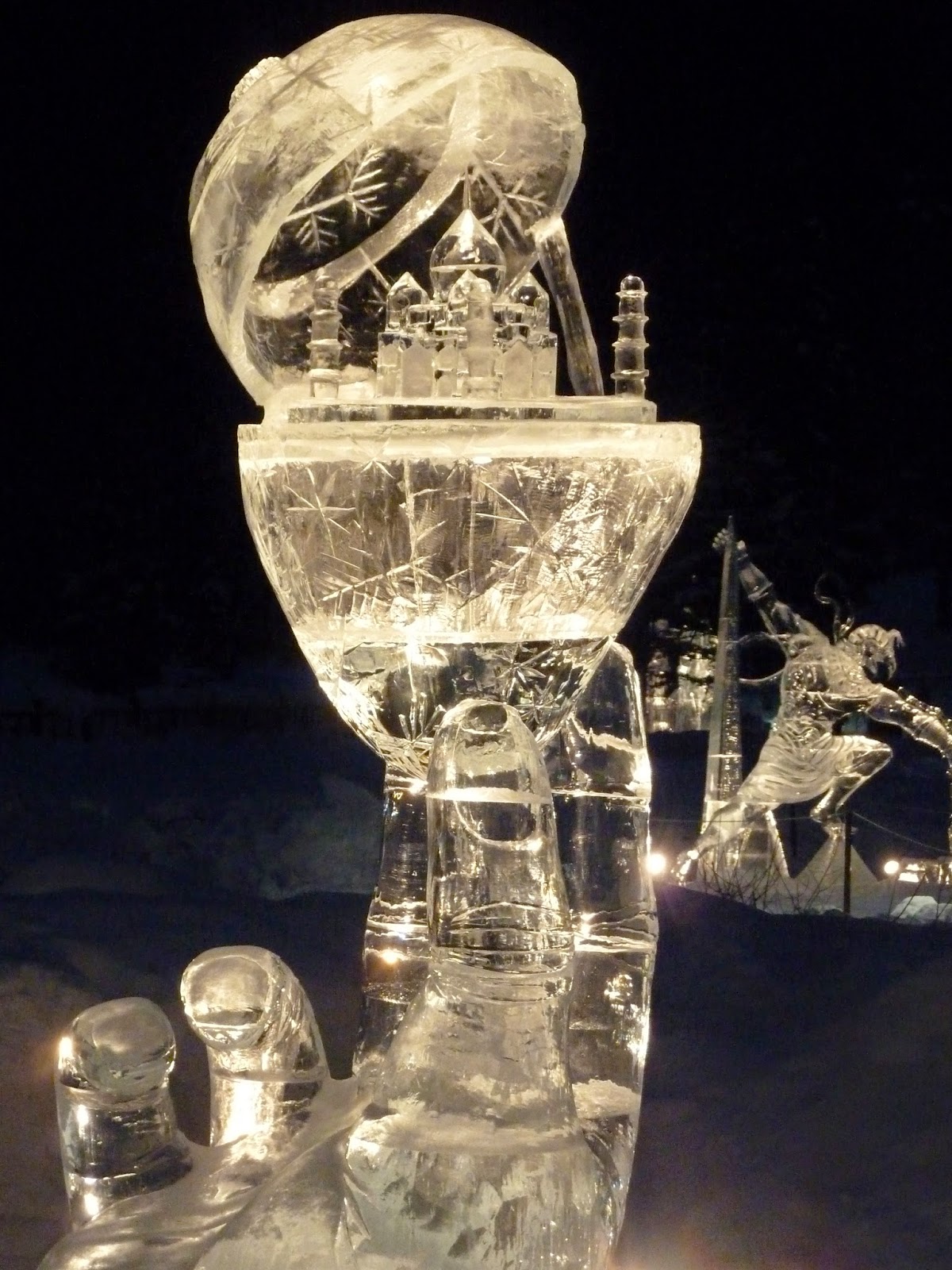
We were up at Lake Louise to see the ice sculptures this evening, a day after the carvers put the finishing touches on their creations at the annual “Ice Magic” festival. Ten teams were given a dozen 300-lb blocks of ice each, and it is truly astounding to see the results of their efforts.  Our favourite was the "Wonder of the World by Faberge," with a giant hand holding a giant egg, which in turn contained the Taj Mahal.

Seeing these sculptures reminded us of how beautiful ice can be, and how there are frozen works of art everywhere in this park.  For instance, we'd been down to the end of the lake a few days ago, and seen some of nature's Ice Magic at “Louise Falls.” These falls form every winter, as there is a permanent spring at the top of one of the lakeside cliffs.  Even with a flow rate of only a few litres per minute, by mid-winter, the water dribbling out freezes into an impressive 100 metre tall ice column.
Louise Falls

Earlier this month, at Lake Minnewanka, near Banff, the lake ice was frozen thick enough for skating, and the trapped air bubbles in the ice again made for exquisite and impressive art.

Air bubbles at Lake Minnewanka

Tonight, we've gone through our photo album, and pulled out a few of our favourite “frozen fotos.”  We hope you enjoy the Ice Magic!

ps: the ice sculptures at Lake Louise usually stay in really good shape until early February, if you want to come to see them.

Skating at Lake Louise in November

Frost flowers and frost heaves at Vermilion Lake, near Banff in November

Frost on water birch leaves in September

The Upper Victoria Glacier at sunrise in July

Early ice in October in one of the side channels of Paradise Creek

Surface hoar frost on the snow near Lake Louise

November 16, 2014

What's with all the Frost Flowers?


One week ago, after a long spell of milder than average weather, it suddenly got cold and clear. Winter had arrived all at once.  For six nights in a row, until last night, we hit -24 degrees C here in Lake Louise.  As expected, our lakes began to freeze, but instead of nice clean ice, which we love for skating, every lake was soon covered in "frost flowers."  They're beautiful, but last winter we managed to skate on lakes that were mostly free of these frost flowers, and we wondered, "why the difference?"

Frost flowers at Vermilion Lake
Well, it turns out that researchers Robert W. Style and Grae Worster have answered that question.  In 2009, they published "Frost flower formation on sea ice and lake ice" in a journal called "Geophysical Research Letters."  Their article showed that the flowers do not form like conventional frost, in which water vapour in the atmosphere condenses and freezes on a cold surface. (This is the normal way you end up with frost on your car windshield.)

Instead, when there is a strong temperature differential between the newly formed ice and the air temperature, moisture sublimates right out of the ice and freezes into frost crystals.  Once the flowers are in place, even if the air itself is very dry, they continue to grow as long as the air temperature remains below about -15 degrees C.

Smooth ice at one of the ponds near Field, B.C.
So the mystery is solved.... or is it?  Today, we went to Yoho Park, west of Lake Louise, and skated on the ponds near Field.  They were clear and smooth.  Where were the frost flowers?

The answer is that it needs to be calm for them to form.  Most places here in the Rockies were dead calm this week, but not Field.  It sits below Kicking Horse Pass, where the cold, high pressure air squeezed through to create a strong local wind. Wind is the enemy of frost flowers. According to the researchers, "frost flowers are typically only seen at wind speeds below about 5 metres per second: at higher wind speeds, turbulence mixes the region of local supersaturation with the drier air above."

If you like lots of math, here's the full story, but frost flowers or not, being outside on our frozen lakes has been great fun.
September 23, 2014

A Fireweed Summer and a Fireweed Fall

This year we had perfect conditions for fireweed, one of the showiest wildflowers in the Rockies.  If you visited in August, you couldn't help but notice their hot pink blossoms, especially in areas where fires burned in 2003.


Now that it's September, the fields of fireweed are the gift that keeps on giving.  In the first two weeks of the month, the leaves turned a beautiful burgundy, and now, in the past week, the seed pods have been splitting open, releasing what might be the lightest and most abundant seed in the Rockies.

Fireweed leaves turning burgundy, with some harebells in the mix.
I did an experiment last week, opening up a seed pod and doing a seed count.  I ended up with 581 seeds, and given that a portion of the seeds blew away in a gust of wind (before I moved the experiment inside), my guess is that there may have been 750 or 800 seeds in the pod.  Each fireweed plant can have several dozen seed pods, and if you start doing the math, that means billions or trillions of seeds produced in the park this summer.

There were 581 seeds in this one fireweed seed pod (plus the ones that blew away).

A field of fireweed going to seed yesterday on the Highline trail near the Plain of Six Glaciers.
North of Lake Louise, there was a fire in early July along the Icefields Parkway, the road to Jasper.  By next summer, the seeds from this year's bumper crop of fireweed will germinate, and in a few years, there will be fabulous roadside viewing.

Happy first day of autumn everyone!

August 12, 2014

Top Secret Burgess Shale Fossil Site

This week has been full of exciting events.  On one of our hikes, we saw a grizzly bear (at a safe distance).  It was a highlight moment for everyone.

The bear was a little too far away for a photo, but a couple of days later, at our lunch stop on the Plain of Six Glaciers Trail, we saw a tremendous icefall off the Upper Victoria Glacier. This time, we all managed to get good photographs.

The biggest highlight of the week, however, was a field trip with some of our Parks Canada colleagues to a newly discovered outcrop of the Burgess Shale fossils in Kootenay National Park.  We're not allowed to divulge its location -- all we can say is that it was a real slog to get there -- but it was a real treat to be in a location where fossils of creatures that have not seen the light of day in over 500 million years are being exposed through careful quarrying.

Sydneyia inexpectans, exposed to sunlight for the first time in over 500 million years

We were shown the day's findings, which included a perfectly preserved Sidneyia inexpectans.  I got to hold it in my hand, and I was blown away by the idea that until that morning, it had been hidden in stone for half a billion years!

Jean Bernard Caron (top right) examining a freshly split open piece of shale

We also got a great site tour by Jean Bernard Caron, Curator of Invertebrate Palaeontology at the Royal Ontario Museum.  He went back and forth between answering our questions, and examining freshly split open layers of shale.  If you are a fossil fan, the ROM's web page is full of great photos of fossils from the Burgess Shale, and animations of the creatures, including my new pal Sydneyia.

Definitely a highlight of my summer.  How many times can you say "that rocks!" and really mean it? 


July 22, 2014

"Clive" – The Salt Loving Marmot

Two weeks ago, we were up at Helen Lake, and after settling in for lunch, a very bold marmot approached our group.  We figured it had been fed by other hikers, but it showed no interest in our food.  Instead, it marched over to one of our backpacks and started licking the straps.

We were all pretty surprised, and stayed still to watch. In very short order, it became clear that the marmot had a major salt addiction.  It visited each of our packs in turn, and then decided to try other options, eventually licking one bare arm and one pant leg.  It was fascinating to watch, because we rarely get close to marmots.  Everyone was so enthralled that we decided to give the marmot a name, just for the day.  One of the guests settled on 'Clive'.

Clive discovers the motherlode of salt  –  hiking pole handles
We figured it was a one time craving, like when you've just gotta have potato chips.

But we were back at Helen Lake yesterday, and so was Clive.  His (or her  – it's hard to tell) addiction had not abated, but this time Clive discovered something even better than packs – hiking pole handles.

We have another trip running to Helen Lake this Friday, on July 25, and we will be on the lookout to see if Clive is still there for another rare close-up encounter.


Clive entertaining our gang of hikers on yesterday's hike

Clive the marmot checks out his namesake backpack


July 9, 2014

Cone Crop of the Century, Part III - The Next Generation

Last September, and again this February, we wrote about the bumper crop of cones on our spruce and fir trees during the summer of 2013.

On today's guided hike up to Yoho Lake, we talked about the ability of subalpine fir to germinate in the snow, and to grow a taproot – up to 3 cm long – right after germinating.  This long taproot allows it to get a foothold in the mineral soil that's under all the leaf litter, and makes the fir superb at regenerating in shady, mossy subalpine forests.

subalpine fir with taproot
Well, talking about it is one thing, but seeing it is another.  A few minutes after our discussion, we found ourselves in a patch of snow, and there they were!  Dozens, maybe hundreds, of little fir seeds from last year's bumper crop, happily germinating and growing their epic taproots.


Then, to complete the story, a few minutes later we stopped for good views, and around our feet were baby fir trees, maybe a month old, sprouting their first needles.  My photo is a bit blurry, but you can see the first two needles, ready to start photosynthesizing.

baby subalpine fir, with its first needles

June 22, 2014

Boreal Toads on the Move

Yesterday we were hiking in Paradise Valley, and we met two boreal toads migrating from the forest towards the creek.  It was a good thing that they were moving, because otherwise they're really hard to see.  Today I realized that I didn't know much about toads, so I thought I should find out a bit more.


It turns out that boreal toads deserve a bit more admiration from us.  They are the highest elevation amphibian in Canada, and to get through winter, they hibernate underground for up to six months, staying below the frost line.  According to researchers, they mostly use the burrows of golden-mantled ground squirrels, sometimes even sharing them with the squirrels!  The burrows need to be deep enough to prevent freezing, so toads will hibernate up to 1.3 m underground.

Life in the mountains is tough, so female toads lay between 5,000 and 15,000 eggs in late spring to keep the whole show rolling.  Since they live so high, and lay so many eggs, boreal toads contribute a lot to high elevation wetlands: the eggs and tadpoles are food for many aquatic critters.  One time in Kananaskis, we saw a huge school of toad tadpoles, and we both thought, “that's a lot of food.”

The tadpoles transform into toadlets in a couple of months, and then leave the water, which might seem weird, since we usually think of amphibians as aquatic, but boreal toads are mostly landlubbers.  They eat bugs in the forest, and only come back to the ponds for breeding.  They can live to be 12 years old.

One final reason to admire boreal toads: they're beautiful, in their toady kind of way.